ANALYSIS OF RISKS AND OPPORTUNITIES OF RARE EARTH ELEMENTS FOR FINANCIAL INSTITUTIONS IN CANADA
 Martinez Hernandez, J. & Martinez-Torres, H., 2026
Abstract
Rare earth elements (REEs) are critical inputs for strategic industries, exposing financial institutions to supply chain risks through credit, valuation, and investment channels. China’s dominant market position creates persistent geopolitical risk, expected to remain even in optimistic scenarios, meaning Chinese trade and industrial policy must be embedded in asset risk assessments. Financial institutions face both risks and opportunities: While supply disruptions can impair borrowers and investments across the REE value chain, growing domestic supply chain investment and recycling initiatives create new prospects. Project valuation must account for price volatility, infrastructure constraints and system-level dependencies beyond the project itself. Environmental liabilities should be priced across the full lifecycle, and Indigenous consultation and benefit-sharing structures treated as material determinants of project viability, not secondary considerations.
Executive Summary
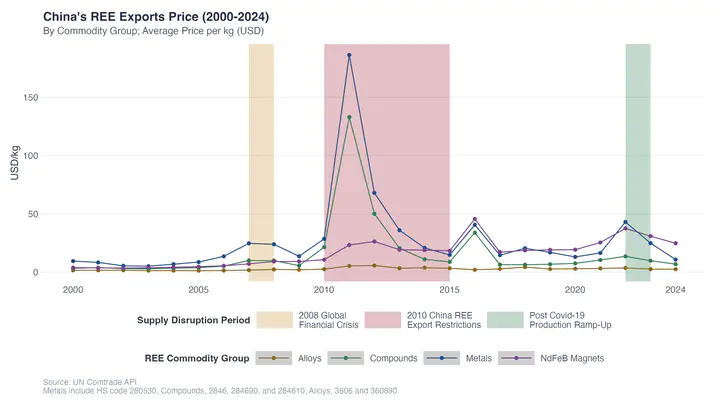
Rare earth elements (REEs) are critical inputs for strategic industries and are relevant to financial institutions because disruptions in the REE supply chain can affect credit default risk, asset valuations and investment opportunities across multiple sectors. Growing demand, limited substitutes in key applications, and a geographically concentrated market supply make REEs susceptible to supply disruptions and geopolitical risk, as China’s 2010 export restrictions have shown. The concentrated market structure can transmit shocks to firms operating along the supply chain and, ultimately, to financial institutions that lend to, insure or invest in them.
We identify and discuss the transmission channels of two sources of risk in REE projects for financial institutions: 1) Geopolitical risk arising from the REE market structure, and 2) Operational, social and environmental risks specific to the Canadian context. We also identify three main opportunities for financial institutions: 1) Financial services for REE firms, 2) Investment opportunities created by public efforts to expand domestic supply chains, and 3) Investment in projects developing recycling and e-waste recovery.
Geopolitical risk is not expected to decrease, as even in the most optimistic scenarios, high market concentrations are forecasted to persist until 2050. Given this outlook, financial institutions should include China’s strategic behaviour (trade and industrial policies) in risk assessments of their assets and investments with exposure to the REE supply chain. Valuation of REE projects should account for the possibility that successful supply expansion lowers prices, paying attention both to the segment in which the project operates and to effects across the wider supply chain. Lower prices may weaken the economics of some upstream projects, even while improving conditions in other segments of the supply chain. This means assessing credit default risk for firms along the supply chain and analyzing the effects of price volatility on equity valuation. In addition, projects should be assessed at the system level, because infrastructure constraints, permitting delays, and other external enabling conditions can materially affect timing, costs and expected returns even when the project itself (e.g., a mine) performs as planned.
Finally, we also highlight that environmental and Indigenous-related social risks should be treated as central determinants of project viability. Environmental risk should be priced over the full life cycle, since remediation and containment obligations can remain even after operations cease. Indigenous-related social risk must also be incorporated directly into valuation and due diligence, because consultation, governance arrangements and benefit-sharing structures can materially affect community support, and therefore the political and social viability of a project.